
The Nuclear Fuel Supply Chain: Why Conversion Capacity Is the Bottleneck Nobody’s Talking About
Written by Ryan Tourigny, Chief Development Officer at Nucleon Energy
Nuclear energy is entering a significant growth phase. Reactors are moving from concept to construction across North America, federal governments are backing the industry with real dollars and policy, and demand for reliable, carbon-free electricity is climbing.
There’s a catch, though: this growth can’t happen without nuclear fuel, and getting fuel ready for a reactor takes more steps than most people realize. This process is called the nuclear fuel cycle.
Conversion is a key step in this fuel cycle, and it’s a process that rarely makes headlines, despite the fact that global capacity to do it is running dangerously thin. As nuclear demand accelerates, closing this supply chain gap is quickly becoming one of the most important (and overlooked) challenges facing the industry.
This article breaks down what nuclear fuel conversion involves, why the current supply is falling short, and what it will take to close the gap.
The Nuclear Fuel Manufacturing Process
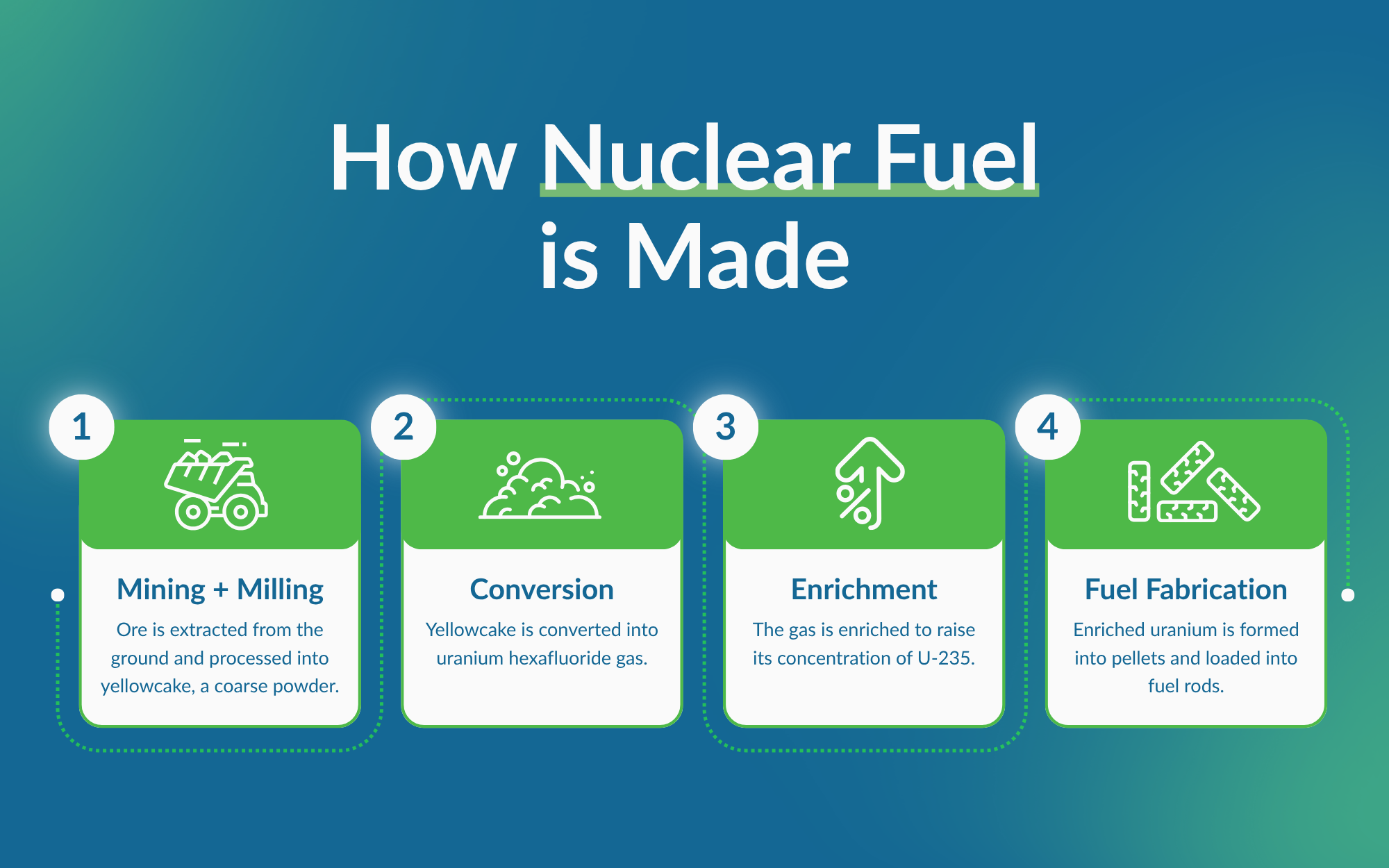
Uranium is the raw material that powers nuclear reactors, but it doesn’t go straight from the ground into a reactor core. In reality, natural uranium goes through four distinct stages before it generates electricity:
- Mining and milling
- Conversion
- Enrichment
- Fuel fabrication
Mining and milling comes first. Uranium ore is extracted from the ground, then processed on-site into a coarse powder called yellowcake. At this point, the uranium isn’t usable in a reactor yet, and it still needs to go through some serious chemistry.
Conversion is next. Yellowcake gets refined to remove impurities and converted into uranium hexafluoride, or UF₆. In the case of heavy water reactors (CANDU) a different conversion process is used. For all other reactors, the UF₆ can be stored as a solid and easily heated to make a gas. This step matters because the next stage, enrichment, can only work on uranium in gaseous form, so conversion is what makes enrichment possible in the first place.
Enrichment increases the concentration of U-235, the uranium isotope that splits apart to release energy. Natural uranium contains only a small fraction of U-235, and enrichment raises that concentration to the level a reactor needs to sustain a nuclear reaction. The same UF₆ from the conversion process can be enriched for fuel for both legacy reactors and for the modern innovative reactors using HALEU fuel.
Fuel fabrication is the final step. The enriched uranium is converted back into a solid, formed into small ceramic pellets, and loaded into metal rods. Those fuel rods are what actually go into a reactor core.
 The Critical Step With A Dangerously Thin Supply
Here’s the part that should give the world pause: only five commercial conversion facilities operate globally, located in Canada, China, France, Russia, and the United States.
That’s a remarkably small number of facilities to support a global fleet of hundreds of reactors, and the concentration gets more concerning when you look at who controls that capacity. Russia alone is estimated to control roughly 20% of global conversion capacity and 46% of global enrichment capacity. Combined with China’s share, a significant portion of the world’s fuel conversion infrastructure sits outside Western control entirely.
For an industry built on long-term planning and decades-long operating licenses, this is a major structural vulnerability. A delay in one area of the nuclear supply chain will eventually (if not addressed) constrain how quickly, and how reliably, nuclear energy is accessible in the Western world.
Why This Matters Now
This concentration problem would be manageable if global nuclear demand were flat. It isn’t.
According to the International Energy Agency, nuclear reactors with a combined capacity of roughly 78 gigawatts are currently under construction across 15 countries, among the highest levels seen in three decades. The International Atomic Energy Agency’s high-case projections have global nuclear capacity more than doubling by 2050, reaching roughly 2.6 times 2024 levels. Much of that growth is coming from advanced reactors and small modular reactors (SMRs), many of which require fuel specifications that today’s aging conversion infrastructure was never designed to support.
At the same time, there are currently no commercial-scale facilities in the United States capable of producing high-assay low-enriched uranium (HALEU), the fuel type many next-generation reactor designs are built around. So, this isn’t a hypothetical future problem, but a gap that already exists today, while demand for fuel is accelerating.
Put simply: the industry is asking its fuel supply chain to do more, faster, with infrastructure that was largely built for a different era, and with a meaningful share of that infrastructure controlled by countries that don’t share Western energy security interests. Waiting until demand fully outpaces supply isn’t a strategy so much as a bet against the industry’s own growth.
North America’s Moment, and Nucleon Energy’s Role
Governments on both sides of the border are starting to treat this as the strategic issue that it is.
Canada’s federal Nuclear Energy Strategy, released in June 2026, explicitly names expanding uranium production and nuclear fuel opportunities as one of its core pillars, recognizing that fuel sovereignty is just as important to Canada’s nuclear ambitions as reactor deployment itself. South of the border, the U.S. has unlocked $2.72 billion in federal funding specifically aimed at rebuilding its domestic nuclear fuel supply chain, a clear signal that American policymakers see the same gap.
This is exactly the gap that Nucleon Fuel (a subsidiary of Nucleon Energy) was built to help close.
Nucleon Fuel’s SMT-5000 is a proprietary uranium conversion module designed to produce roughly 5,000 tonnes of uranium hexafluoride annually. It’s being developed with a focus on modern infrastructure, safety, energy efficiency, and long-term reliability, built for today’s standards rather than adapted from decades-old facilities. Nucleon Fuel is actively evaluating strategic sites across both Canada and the United States, assessing infrastructure readiness, the regulatory environment, and long-term operational suitability, with the goal of adding real, domestically controlled conversion capacity where it’s needed most.
This is still early-stage work, and it should be understood as exactly that: one credible step toward addressing a supply chain gap that the broader industry and government bodies are beginning to recognize in earnest.
 Bottom Line: We Need to Be Talking About Nuclear Fuel
Reactor technology gets the headlines. New designs, faster deployment timelines, and ambitious capacity targets are the parts of the nuclear story that are easiest to get excited about. But none of it matters if the fuel supply chain underneath it can’t keep pace.
Conversion is one of the least visible steps in the nuclear fuel cycle, and one of the most strategically important. With global demand rising, aging infrastructure concentrated in a handful of facilities, and a meaningful share of that capacity controlled outside the West, closing the conversion gap is fundamental to whether North America’s nuclear ambitions can be delivered on schedule.
To stay informed on how the nuclear fuel supply chain and the broader nuclear ecosystem are evolving across North America, follow Nucleon Energy on LinkedIn. For a deeper technical look at the SMT-5000 and Nucleon Fuel’s approach to conversion, visit the Nucleon Fuel page.